
Project Update: Interoperable Deliberative Tools in 2026
The 2026 deliberative tools and interoperability working group updates you've been waiting for


We’re back with another update on the Interoperable Deliberative Tools Cohort (IDT, or “Interop”), one of Metagov’s largest and most active research areas. Interop has matured wildly over the past two years moving from a small grant program which gave over 21 teams a grant to build flatfiles to a robust research area involving 30+ teams and individuals working across many working groups towards the joint mission of making today’s collective intelligence tools more open, modular, and interoperable, laying the groundwork for a capture-resistant ecosystem of deliberative tooling in which process innovation thrives and local creativity blossoms.
It’s hard work - and we’re ever working towards building better ways to do that. This post is an update and an invitation to join us as we continue to grow this research area.
For those who are new here, here are the Interop plot points:
May 2024: the Mina Foundation (THANK YOU) allowed founding Research Director Aviv Ovadya to distribute $200,000k through a Metagov grant program for Open Source Deliberative Tools that prioritized interoperability.
July 2024: We gathered 21 teams to approach interoperability questions together.
September 2024: we posted a midterm report.
October 2024: we hosted an on-site where each team demonstrated its individual work towards meeting minimum viable interoperability standards defined as an exportable flat file with a defined data structure. Thereafter, we shifted our priority from individual work to collaborative work.
January 2025: our five-day online symposium celebrated the progress made during Interop1 and launched six working groups to grapple with the gnarly details of making functional interoperability among open-source, deliberative tools a reality.
May 2025: We announced the activities and impacts from the 1-year funded program.
June 2025: the six working groups came together for a mid-year Research Area Roundup to brief each other on their progress and check alignment. This post captures their ways of working, achievements, and explains how new contributors might get involved.
August 2025: The data mesh team got together in Denmark to build the first draft of an ontology!
June - December 2025: The AI Facilitation team had seminars with 7 facilitators + researchers to better understand how AI fits in facilitation and the different facilitation methodologies in Deliberative Facilitation.
October 2025: The Data Mesh team assembled a prototype across multiple tools to test at the Foundations for the Digital Commons event in Maine.
November 2025: The AI Facilitation team was joined by Maria Milosh - and she opened a collaboration with Oxford focused on researching the effect of cross-pollination.
January 2025 - the working groups gathered again! And this is the report from that conversation :)
The Interoperable Deliberative Tools Research Area
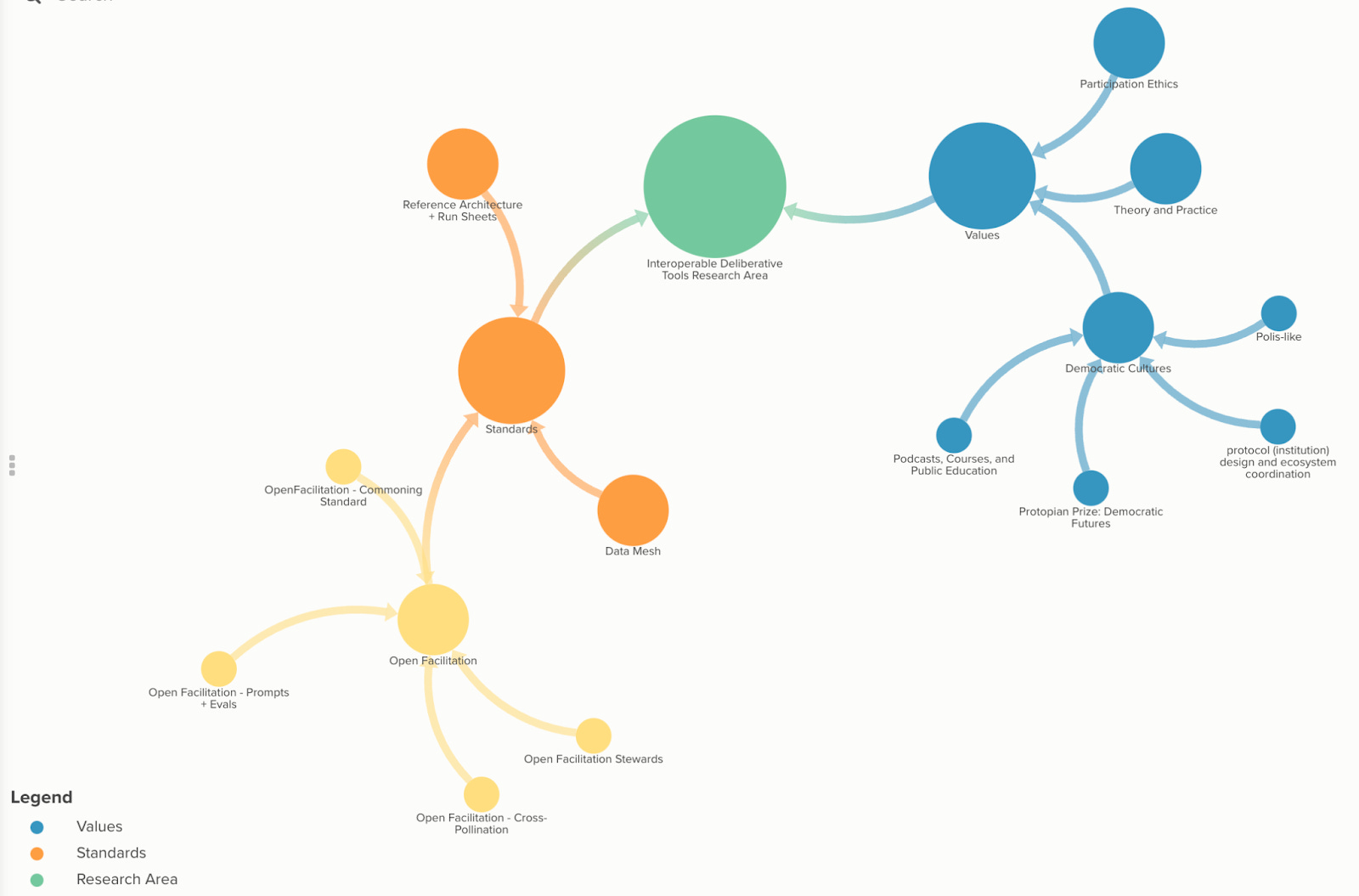
This research area is bubbling with working groups, each focused on pushing forward critical components of the mission we described above. Working groups are how we organize work at Metagov and are the places where individuals, early-stage tools, mature technologies and organizations can work together to achieve fundamental R&D of benefit for all, issued as digital public goods. In all of our research areas, Metagov strives to be “hub-shaped.” By holding the center, the coordination, and the institutional logistics needed to move forward collectively, each working group is fundamentally modular and free to define its own scope, pursue funding, and work towards the needs of those who join.
Metagov is Hub Shaped
Audrey Tang
The figure above shows how the research area on interoperable deliberative tools has emerged into two themes, which we colloquially refer to as “Hard-line values” and “Feel-good Standards” (thank you, Audrey Tang, for the framing :).
From there, each theme splits into working groups, which further subdivide as the work becomes more defined. Each working group has membership boundaries and a lead. Lee DeSota is Lead Facilitator and Project Manager for the entire research area. The research area is directed by Liz Barry, with occasional essential support from Metagov RDs Aviv Ovadya, Amy Zhang, Eugene Leventhal, and Josh Tan.
⭐️ If you have an interest in this topic generally, the place to get started is the lobby channel in Metagov Slack: #deliberative-tools-and-interop
Table of Contents:
The Interoperable Deliberative Tools Research Area
Standards
Data Mesh
Open Facilitation Library
Reference Architecture
Values
Participation Ethics
Theory and Practice
Democratic Cultures
Conversa: exploring Polislike tools and practices
Democracy Innovators Podcast
Conclusion
Standards
This theme standardizes a sociotechnical vocabulary and ontology for deliberative tooling
Data Mesh
Purpose:
We are building an ontology that allows deliberative tools across the governance cycle to translate their data, enabling easy communication between many tools.
We see an open-source ecosystem that is resistant to capture by corporate entities, where the tools we use to govern ourselves are themselves governable.
Scope leads: Stuart Lynn
Updates:
Deliberative Tooling Ontology: This group is building a data mesh model where each tool maintains control over its data + ontological structure while also aligning with collective standards to promote interoperability between many tools without needing to create pairwise integrations for every tool.
Public Presentation + Feedback: Authored a Work-In-Progress publication on the model above for data exchange between deliberative platforms and was accepted to Aarhus 2025. Presented a poster at the conference.
Poster
In-person events: in-person events that convene semi-monthly and rotate regionally around the world as opportunities arise in partnership with other events / conferences that bring people together.
Attended Foundations for the Digital Commons in Maine
Implementations: StartinBlox + Open Source Politics already implemented the Ontology in the primary implementation of their Democracy Data Space, and we’re excited to hear more on how that system is working!
Upcoming Work:
Crownshy, Maggie Hughes, and Iswe Foundation are co-authoring another upcoming paper.
The Data Mesh working group is focused on expanding the ontology to better fit different tools, including incorporating pre-existing ontologies with Simone Vagnoni.
Call for Participants:
Looking for participants who are either
Managing or building a governance process that requires interoperability between several open source tools.
Working with an open source tool they want to make it interoperable with other tools in the context of a governance process.
To see the work + stay updated when we’re inviting new participants, join #data-mesh on the Metagov Slack.
Open Facilitation Library
Purpose:
Build a shared library and synthesize standards that can train human and machine agents to better facilitate discussion towards our collective shared goals.
We want collective intelligence, self-rule, and human cooperation at scale to be both possible and commonplace.
Scope leads: Artem Zhiganov, Maria Milosh, and Cecile Green
Updates Work:
Open Facilitation Library Synthesis: This scope is led by Cecile Green and the Commoning Standard team and is working to synthesize various contributions including deliberative facilitation frameworks into the current version of the Commoning Standard.
Current integrations in process with Rosa Zubizarreta, Andy Paice, Greg Cassel, several researchers in Germany, and Metagov’s own Liz Barry!.
Looking to build more group processes to expand the integration.
Primitives of Agentic Facilitation: This scope is led by Artem Zhiganov and focuses on designing AI-readable facilitation “primitives” that build off of the synthesized facilitation standards above.
This scope is paused as we search for funding
Open Facilitation Stewards: This scope focuses on developing a sustainable business model that adequately and consistently prioritizes and compensates facilitation knowledge, technical contributors, and standard creators for this knowledge.
Built a first draft of a business model
Focusing on writing grant applications + searching for funding
Cross-Pollination Research: This scope is working with Oxford to build a systematic study of the effects of cross-pollination of ideas in an asynchronous deliberation process on participant voting choice.
Designed an experimental flow
Defined a needed budget
Developed Synthetic participants to evaluate and test the study flow
Working on updating Harmonica with Artem Zhiganov to allow it to properly implement the study conditions.
Call for Participants:
Open Facilitation Library is actively synthesizing facilitation practices and standards. Facilitators, AI/Knowledge Engineers with relevant practices or methodologies, are encouraged to contribute.
To see the work and introduce yourself, join #ai-facilitation on the Metagov Slack.
Reference Architecture
Purpose:
To collaboratively diagram the world’s largest and most complex workflows in civic engagement and democratic innovation. We are establishing generic graphic conventions useful for representing multi-stage, hybrid in-person/online deliberative processes.
We wish to compare implementations of deliberative processes to speed learning for those who design these processes.
Scope leads: Liz Barry and Audrey Tang
Current Work:
Developing a collaborative workbook of visual process diagrams by co-authoring with process designers from initiatives such as Taiwan’s AI Alignment Assembly, Germany’s “Forum Against Fakes,” Brasil’s Participiva, and Tokyo’s AI participatory mayoral campaign.
Each process is mapped using a template that includes phase of deliberation, mode of outreach and sampling, number of participants, mode of connection (in-person, online synchronous/asynchronous), degree of interaction, type of input, type of transformation (technology not namebrand), and outputs.
The focus is on tracking participant health and information health throughout the process.
Call for Participants:
The group invites:
If you are a process designer who has run a large process - please reach out to liz@metagov.org with diagramming in the subject line to become a coauthor on this workbook by collaboratively diagramming your process!
Tool developers who support those processes.
Architects and urban designers who have expertise in diagramming abstract machines; please note that this is different from data viz or storyboarding.
Participants are welcome to contribute their projects to the collaborative workbook and help improve shared understanding of participatory workflows across tools and cultures. All process designers who contribute their implemented process design become co-authors of this collaborative workbook.
Values
This theme advances core democratic values and articulates the rights of participants
Participation Ethics
Purpose:
We estimate >1M people have already experienced tooling environments created by <1k developers, and anticipate that another million+ will have such encounters in the next 12 months. And as a result, we build legal infrastructure that centers participant ownership over their data instead of participant consent to data right loss.
We want participant rights and ethical data practices to be centered across the ecosystem large-scale deliberation and digital governance—beyond compliance + consent—to ensure people know, understand, and can exercise their rights in participatory contexts.
Scope leads: Liz Barry (Current), Matt Victor (2025 H1)
Current Work:
Working to coordinate a convening to support deliberative democracy specific Identity solutions that ensure participant rights throughout the process.
Building a participant bill of rights for Polis that can be used across different tools, in light of the Polis fork built specifically to meet the European Union’s ethical standards.
Matthew Victor is working on the underpinnings of having a network and data cooperative.
Call for Participants:
Looking for ethics-minded designers, legal thinkers, and framework builders to help make participant rights real, practical, and empowering.
Join the #participation-ethics Slack channel on the Metagov Slack.
Theory and Practice
Purpose:
To bridge the gap between democratic theory and the design and implementation of emerging participatory tools—so that academic theory informs practice and practitioner insight informs theory.
We work so that the scaling of participation through digital means advances the promise of massively deliberative democracy without fueling technocracy.
Scope leads: Joseph Gubbels (2025)
Current Work:
Look for our next theory reading group in March - follow (ask val what she wants to do and fill in w details!)
Call for Participants:
See the discussion at #theory-practice channel in the Metagov Slack.
Democratic Cultures
This theme is made up of several working groups focusing on bringing in more tool builders and citizens into democratic participation.
Conversa: exploring Polislike tools and practices
Purpose:
To build a peer-to-peer learning and support network for practitioners who use Polis and similar bridging tools—focused on facilitation, re-imagined interfaces, and algorithmic innovation.
Our vision is to foster a space for experimenting with Polis-like tools, so that these tools can support the massively intersectional culture that results from stabilizing as much difference across as many boundaries as possible.
We aspire to help Polis process stakeholders of all backgrounds in learning to understand, to explain, and to defend the methods and trade-offs of Polis-like tools. New exploratory interfaces will support new forms of curiosity-driven “perspective cartography”, helping users to build intuitions around navigating complex topics. Thoughtful and accessible metaphors will allow all of us – curious participants and facilitators alike – to make sense of not only the subtle hidden dimensions of our fellow citizens, but of the very algorithmic processes that reveal us to one another. This emerging and wider field of practitioners – platform maintainers, conversation facilitators, interface designers and data scientists – will openly iterate together on the technical underpinnings of this new class of democratic tool.
Scope Leads: PatCon
Current Work:
Hosting weekly, lightly structured drop-in calls for practitioners. We welcome all silly questions, roaring successes, last-minute demos & hare-brained ideas.
Compiling a comprehensive list of 360+ known Polis conversations and a directory of 700+ people with Polis-related experience.
Cultivating a Discord community (~170 people) for ongoing exchange.
Building and sharing libraries and prototypes: red-dwarf algorithm library, opinion landscape painter, data pipeline explorer, Awesome Polis directory
Crafting thoughtful and accessible metaphors to ground user and facilitator intuitions.
Building + supporting several tools, including Red Dwarf, Perspective Explorer V2, and Valency Anndata.
Call for Participants:
This group is welcoming to folks interested in running Polis conversations, experimenting with new interfaces, and exploring improvements in its algorithmic pipeline.
Join the Polis User Group Discord, drop into a call, read our past call notes, or visit the #polislike Slack channel in Metagov.
Democracy Innovators Podcast
Purpose:
The democracy innovators podcast works to build a platform that gathers inspiration and gives public recognition to democracy innovators. The podcast supports civic tech builders in staying updated and finding collaborations in the civic tech space, and allows the public to discover civic tech and find hope in the work being done.
Scope leads: Carlo Michaelis and Alessandro Oppo
Current Work:
Recording a civic tech podcast called the democracy innovators podcast
10 months
35 interviews (37 videos)
> 3200 listeners (Youtube + Podcast)
> 3300 hours listening time (Youtube + Podcast)
> 160 LinkedIn Followers, > 80 Youtube Subscribers
Call for Participants:
Go subscribe and listen to all the episodes :) If you want to be interviewed, volunteer, or fund the project, reach out to @alessandrooppo or @carlomichaelis on the Metagov Slack or via email to democracyinnovatorspodcast@gmail.com or alessandrooppo@gmail.com.
Keep an eye out for:
DRI in Polis is currently paused - but you can join the #dri-in-polis channel and chat there if you’re interested in this experiment!
The Democratic Cultures group is currently growing, and we’ll announce those projects you see in the working group diagram as they emerge!
Conclusion
Over the past two years, we have consistently worked towards building alignment across the Deliberative Tooling ecosystem through these working groups. There is still a huge amount of work so if you’re a builder, a funder, or a citizen. Come join us!
We’ll be back again to keep you updated as we continue to build towards a modular, governable, and capture-resistant ecosystem.