
The Protopian Prize is delighted to announce our inaugural winners! The Prize invited authors to share visions of people working toward liberatory futures, meeting obstacles, and making real change. Protopian stories imagine a future neither flawless nor catastrophic, but workably better than today. It’s about plausible progress rather than perfection or collapse.
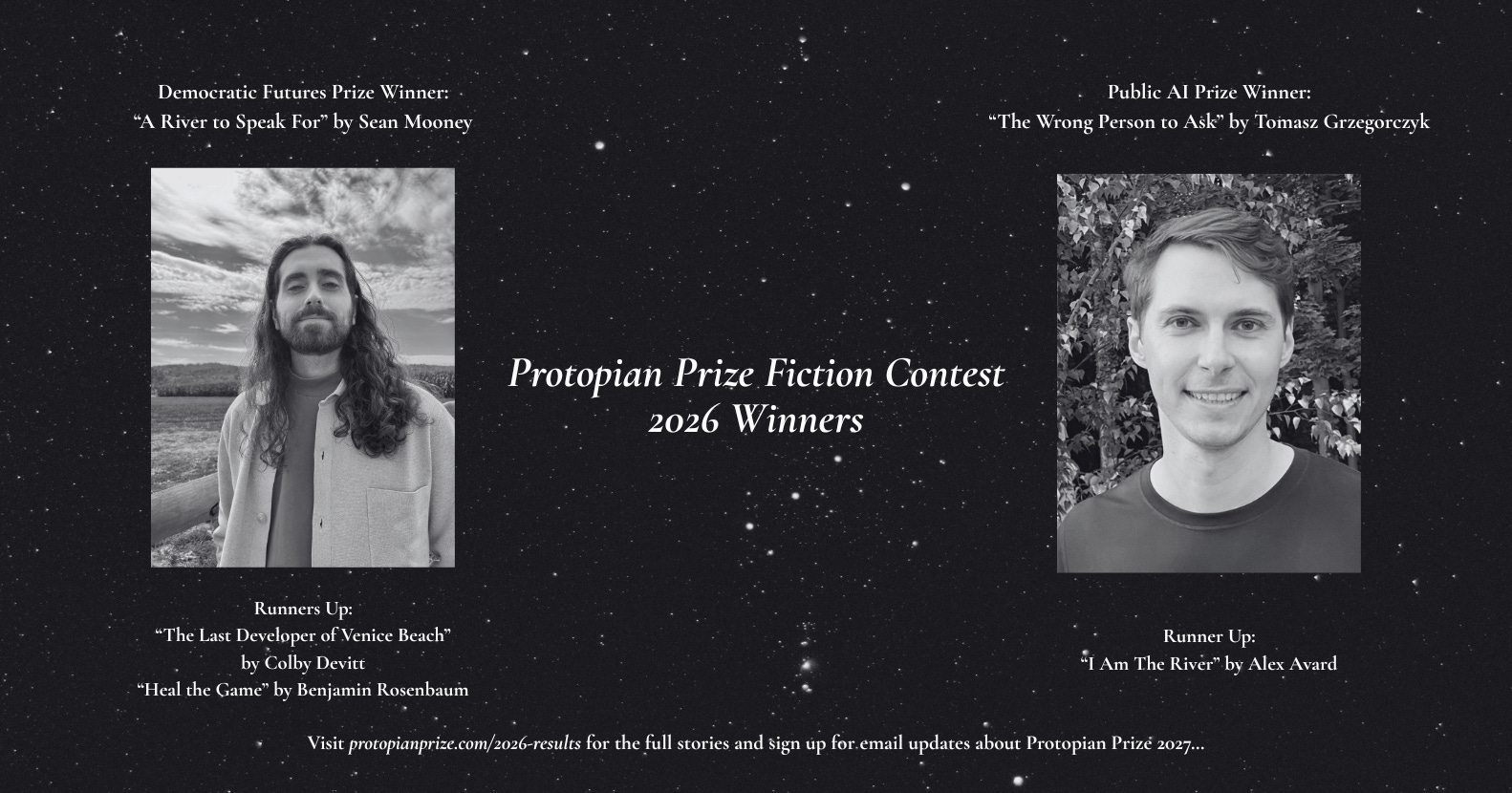
This year, we offered awards in two categories. The Public AI category sought alternatives to the paradigm of centralized corporate ownership—AI as infrastructure, accountable to the public and designed for public benefit. Tomasz Grzegorczyk’s “The Wrong Person to Ask” depicts the ombudsman for European Public AI handling a controversy over the regulation of human/machine intimacy, even as he struggles with his own loneliness. It explores why people might seek AI companions rather than human ones, and the thorny issues involved in constraining or allowing unhealthy choices.
The judges loved how the story wrestled multiple ethical quandaries that might arise from providing public-interest AI services, highlighting both the potential for good and the complexities that could arise. Grzegorczyk is an Assistant Professor at Poznań University. His story draws on his research examining how people evaluate and accept artificial intelligence and other emerging technologies, and how these technologies affect organisations.
The Public AI runner-up is Alex Avard’s “I Am the River,” a poetic depiction of human and natural grief, and how an AI agent might speak for both.
The Democratic Futures category sought stories reimagining the mechanisms of collective governance, and the societal structures needed to enable them. Sean Mooney’s “A River to Speak For” depicts the apprentice of a dying river-speaker, navigating a controversial clean-up proposal while trying to grow into her mentor’s shoes. It imagines fossil fuels as an addiction parallel to the opioid epidemic, and responsible governance as collective acceptance of responsibility, parallel to individual recovery work.
The judges loved Mooney’s thoughtful treatment of a debate in which no one is truly wrong, but competing needs are very real. It’s protopian in the truest sense. Mooney says, “I think it’s possible for us to create a better world.” His story makes that believable, even as characters deal with limited resources and human foibles. “A River to Speak For” draws on his studies of ecological psychology as well as personal experience with addiction and recovery.
The Democratic Futures judges also chose two runners-up. Colby Devitt’s “The Last Developer of Venice Beach” tells the story of a land use debate from the perspective of a bat, in a world where AI has enabled limited communication with non-human animals. Benjamin Rosenbaum’s “Heal the Game” imagines a restorative justice system that seeks not only to mend relationships, but to fix the systems that make crime more likely.
Winning stories received $5000 awards, and will appear in an upcoming anthology, In the Loop: Stories From the Future of People, Power, and Machines from MIT Press. Winning and runner-up stories are also available on the Protopian Prize website.
Metagov, the Prize’s core sponsor, will be celebrating the winners at Mozfest in Barcelona on October 28th. We will also be sharing analyses of submitted stories, and offering workshops on protopian writing, at upcoming events throughout the coming months. Stay tuned for our announcement of topics for the 2027 Prize!
So exciting! Can we pre-order the book somewhere?