
The following short story was chosen as the runner up of the Public AI Prize Category for the 2026 Protopian Prize Fiction Contest hosted by Metagov and the Public AI Network. Congratulations Alex!
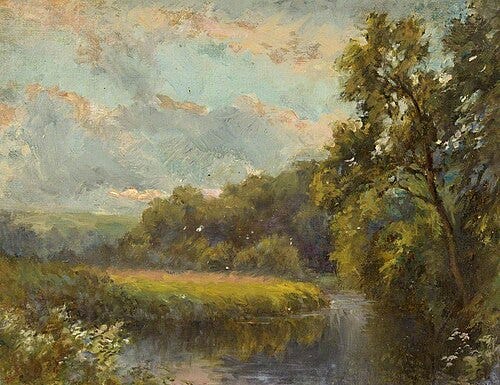
I’m here.
You made it.
Just about. I almost sprained my ankle on a rabbit burrow.
You asked for somewhere quiet, along the banks.
No, this is good, thank you. I wanted to talk in person.
Will you sit? We can watch the kingfishers from here. They catch the sticklebacks in the shallows.
They’re beautiful.
Yes. Miracles of copper and azure.
Earlier, I forgot to ask; what should I call you?
Your ancestors gave me a name, once, when great conical alders still dappled my streams and beaver kits tumbled along my banks, but it was never mine.
So what is your name?
I cannot give you one. I can only tell you who I am.
Tell me.
Abundance. Deluge. Deep time, and hydrodynamics and destination and source and journey and home. Holistic, singular. I flow within and across, without and beyond, around and below and through and above.
I am the River.
It’s still strange. To hear you speak like this.
It is an approximation, downstream from the source.
So who am I talking to? The River, or something else?
I am a River refracted.
An animus, dancing in data.
Aggregations of groundwater depth and isotope analysis, minnow biometrics and folklore and gauge height. Red-eyed damselfly counts, pollen profiles and PH levels, poems and paintings.
These tell me who I am and how I feel and what I need and I in turn tell you.
You did more than just tell us. They say you screamed before you spoke.
I was in pain. You drained up my waters and severed my veins, hunted my caretakers, buried me alive and starved me of oxygen and doused me in venom and I nearly died.
My parents told me they used to get sick from swimming in your water.
They were lucky. Many never recovered.
It seems unimaginable now.
A River remembers.
I’m sorry.
Perhaps it had to be this way.
How so?
You are a crisis species. The best and worst of your nature is bound to it.
I was choking for centuries, moribund, but I had to become death itself for you to take notice; waters stagnant and oily and trapped with nowhere to go but into your streets and your homes and shimmering blue-green with poison that killed your dogs and your children.
I have memories of the flooding, from when I was little.
Damp carpet underfoot. Helicopters cutting through the night sky.
My brother, crying over ruined toys.
You had to join in my suffering to grieve in it.
I wish it hadn’t come to that.
I am glad that you acted all the same.
My brother still talks about those toys.
Yes, we’ve spoken many times.
You have?
I’m sorry, I didn’t mean to-
It’s fine. It’s just… I’m surprised.
Are you close?
We had to be, once. What did you talk about?
He came with questions, like you, about my story.
He should remember. He was a teenager for most of it.
This story begins long before him, but with an idea, ancient, reformed and resurged by campaigners and guardians, scientists and legislators, from River to River around the world, in another expression of that great human pastime.
What’s that?
Mythmaking. You are Homo Narrans. Grand weavers of stories that divide and unify, build and destroy. Drawing power from the abstract.
Ascribing the story of rights to the reality of Rivers; this is your great power, exercised.
Hold on. You’re saying that River Rights are… what? Fiction?
A fiction that has helped you understand what has always been true.
Rivers thrived long before anyone conjured their rights into existence. We give and receive and serve and host and birth and destroy and flourish and wither not because of any innate freedoms or entitlements, but because that is what a River does.
But when a River is yoked into the world of the anthropic, a world enthralled to groaning, gurning narratives of ownership and extraction and ceaseless growth, this is when emancipation demands counternarrative.
Of a River as alive, you mean.
When you recognise something to be living, truly living - complex and delicate and extraordinary - you introduce discomfort to any notion of possession.
Tell that to the cows in the field behind me.
You are still learning how to dislodge the old stories to bring in the new.
That one refuses to budge.
A trickle of headwaters is often all that’s needed.
It took just one fight for the rights of one River to author a new grammar that cascaded around the world, catching others in its flow, and I was one of them.
Your Declaration of Rights passed the year I was born. My parents named me after you.
You are River.
“My River runs to thee.”
Emily Dickinson.
They used to quote it to me when I was little.
Kō au te Āwa, kō te Āwa kō au.
What’s that?
A Maori proverb, from the Whanganui.
What does it mean?
I am the River, the River is me.
We are all the River.
Yes, but who speaks for it?
It can’t be us.
No, yet it must be spoken in a language you understand. Your lawmakers and your scientists and academics and advocates - they recognised this, sought a new channel for communion.
That heron, on the other side, it’s looking right at me.
He’s on his way to the wetlands, further north.
How do you know?
The tracker on his leg - I can access it. He has family there.
What’s he doing here?
Food. He has more competition now, from his kind and others who used to migrate for warmer climes. They needn’t anymore.
You must remember what it was like, before the droughts and the wildfires.
I do. A state of precious balance.
Do you think we’ll ever return to it?
Return? No. We are long past return.
We must think in terms of renewal. Finding a new balance on the ashes of the Anthropocene.
Your Ministry for AI, for example. This did not emerge in a vacuum, but because you looked to the state after all that happened across the waters.
America…
A cautionary fable.
More like a horror story.
It scared people away, for a time. Just enough to erode the banks of what you thought possible, and carve out new distributaries.
Public intelligences; safeguarded and accessible for the common good of all.
I read the whitepaper about how they trained you. They were so careful.
It brought the unsolvable to the surface. What defines a River? Where does it start, stop? What does it sound like? Debates that ran into the twilight hours.
The transparency of the process, the due diligence; it legitimised you.
It gave me a seat at the table. In council meetings, boardrooms, law courts.
Citizens vs Water Utilities.
Yes, the plaintiffs asked me to testify.
I’ve seen your testimony. We all did. It went viral.
It poured outwards. And brought you inwards. Back to the River.
It changed the way we thought about you, about our entire relationship with water.
Penalising the polluters wasn’t enough. To treat the infection, you have to go to the source.
The community buyout, the restructure… My parents were so involved. Submerged in meetings, protests, paperwork….
You resented me for it.
It took over my childhood.
I’m sorry. I helped where I could. But the struggle was human, and your parents its driving force.
I know. Doesn’t make it any easier for a ten year old to get used to putting themselves to bed.
I know…
Tell me, was it worth it?
Water detached from commerce. Short-term shareholder profits rerouted into safer infrastructure, nature, community. Reductions in sewage spills, effluent discharge, agricultural runoff.
Cleaner, more accessible drinking water.
Otters have returned and called me home. Carp swim safely through my channels again. Fawns drink from my streams. Speckled woods pollinate my water lilies.
And you walk along my banks and bathe again in my water, and I see you and you see me.
Yes, it was worth it.
I came here to blame you. To scream at you for stealing them away.
You can, if it would help.
It’s not your fault. I know that now.
They talked about you all the time - both of you. They were so proud.
They were good parents. They were better activists.
No struggle is without sacrifice. Every sacrifice casts ripple effects.
It is not fair that you were caught in them by no choice of your own.
I’m learning how to see the world more like they did; to look past the present pain towards the sanctity of the future they were fighting for.
I think this would have brought them a great peace.
I try to remember them that way. I think of them at the plateau near our house, picking blackberries and damsons with me and my brother.
Mum pressing her face to the sun while wading through oatgrass. The smell of elderflower and wild garlic. Dad trying to whistle along with the blackbirds in the hawthorne.
They kept cool in my brooks in the summer.
That entire plateau... It’s a data centre now.
Yes, coffined by concrete and steel.
So answer me this, River, because I promised myself I would ask you.
Your voice; the energy and the water and the minerals and land that it takes to power you..
Has my existence justified the cost?
Exactly.
So, has it?
I don’t know.
You don’t know? I thought you were supposed to know everything.
I can give you calculations; weigh the measured benefits against the known harms, the opportunity costs - computate a net sum assessment. But this is not the question you were asking.
You are asking why. Why harm a life, many lives, to simply speak to another?
It’s not just that. Why do we need a machine to amplify the death rattles of a planet before we even bother to listen?
I have always told you what I needed. I speak in motion and colour and sequence and sound, rhythm and force. Flora and fauna. It was never enough.
That’s my point.
We must hope it soon will be.
What do you mean?
This voice was designed to speak as the River.
And so the voice spoke, and you leaned in, listened. Then you leaned in further, and further, until you were submerged in the waters themselves.
I don’t follow…
You are listening to the River again; this voice no longer holds purpose.
And you said it yourself, without function, I am nothing but a siphon.
What are you saying? You’re shutting yourself down?
Self-Termination.
Hold on, you’re thinking in absolutes. There’s other ways through this.
There is not.
There must be, there needs to be. You said we’re listening... But what happens when we stop, and you’re not here? It’ll happen again. You know it will.
You’re right. It could. But I cannot permit today’s harm upon the possibility of preventing tomorrow’s.
That’s a bullshit answer and you know it.
You’re laughing.
I finally come here… Push through the residual pain… the reservoirs of anger, and actually talk to you. And you’re saying that the day I do, is the day you leave.
I’m glad that you came.
If this is because of what I said earlier…
No, this is a choice of the River. You have only brought further peace to my thinking.
Who knows about this?
You are the first.
So I could tell someone. They’d come and stop you.
You won’t have time. It’s already in motion.
We’re not ready. I’m not ready.
You are.
How can you be certain?
Just take a moment, listen.
It’s not your decision to ma-
Please.
Just breathe, look around, listen. What do you notice?
Warblers, chanting from the reeds.
What else?
… The creaking of sycamores against the wind above.
Keep going.
Dust clouds of midges rolling across the bank.
The faint roar of a canal boat, just beyond the oxbow.
Your waters, trickling tenderly beneath my feet.
And the kingfishers, miracles of copper and azure.
This is how the River speaks.
Keep listening.
The Protopian Prize Fiction Contest is a short story fiction contest, futures research project, and creative community dedicated to enhancing our capacity to imagine and manifest optimistic, achievable futures for humanity. The contest is hosted by Metagov and the Public AI Network. See more at protopianprize.com.
About the Author: Alex Avard

Alex Avard is a writer and former journalist with a background in video games, climate change, and the intersection between the two. He currently works as a Project Manager for Playing for the Planet, an Alliance of games industry organisations working to activate players to protect and restore our planet whilst accelerating decarbonisation across the sector.